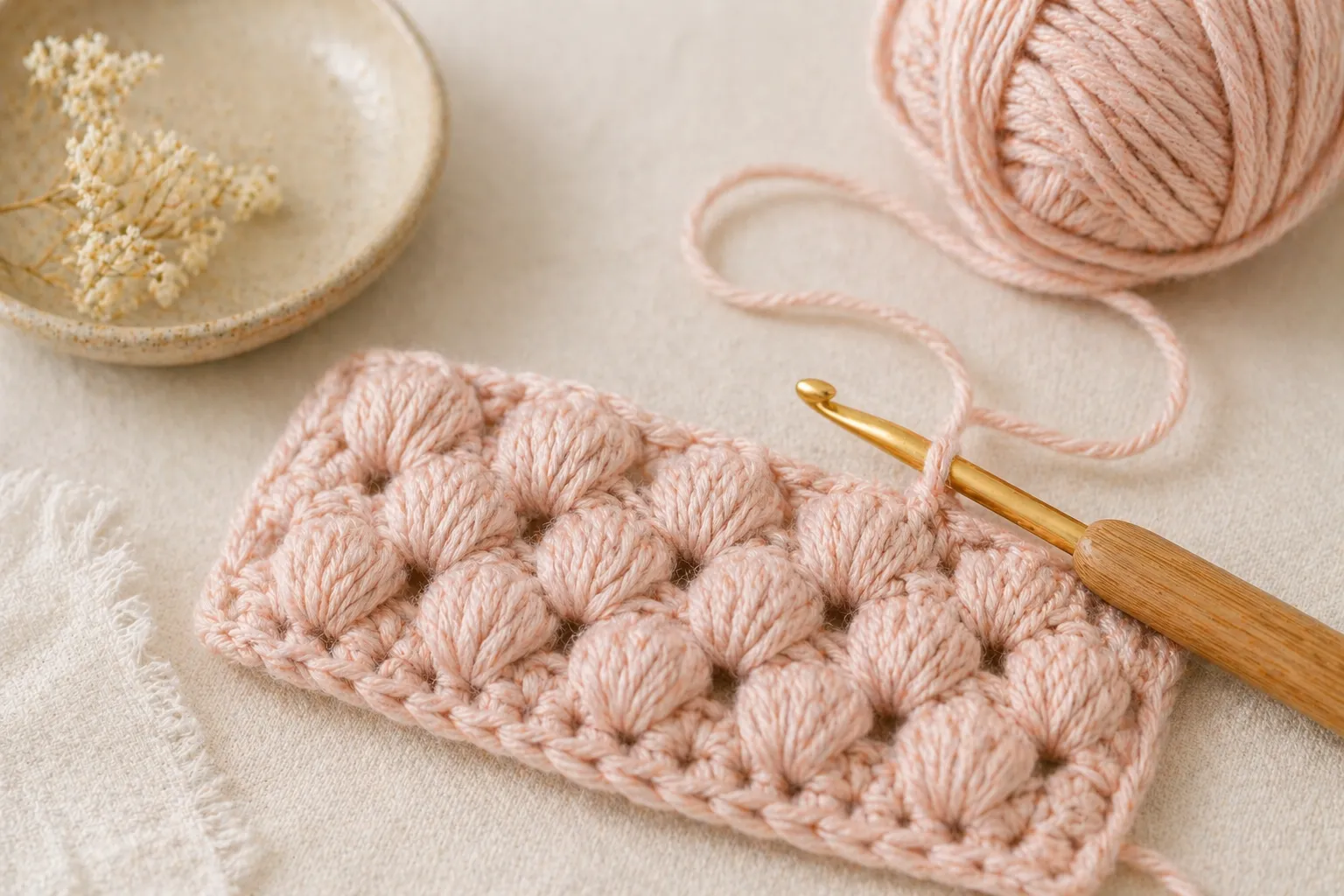
A puff stitch is made by wrapping yarn around the hook and pulling up long loops into the same stitch — usually 3 to 5 times — then closing them all together with a single yarn-over. The result is a soft, squishy, rounded bump that sits rounder and cosier than a bobble. Works best in DK or aran yarn on a 5–6mm hook, and most beginners get the hang of it within 10–15 minutes.
What is puff stitch in crochet?
A puff is a rounded 3D cluster formed by pulling up multiple long loops of yarn into one stitch, then yarn-overing and pulling through all of them at once. Each puff is usually made from 3–5 yarn-over-pull-up repeats. The loops stack softly rather than snapping into a tight knot, giving puff stitch its characteristic squishiness.
The key difference from bobble stitch is in how the loops are formed. Bobbles use completed double crochets stacked into one stitch — they’re angular and defined. Puff stitches use long pulled-up loops that are never completed as individual stitches before the close — they merge into a single rounded cushion. Neither is harder than the other; they produce different textures suited to different projects.
The standard abbreviation in patterns is PS (puff stitch), though some patterns spell it out in full.
How to make a puff stitch — step by step
You need: DK or aran yarn, a 5–6mm hook, scissors.
To make one 3-loop puff stitch (PS):
- Yarn over, insert hook into the stitch
- Yarn over, pull up a loop to approximately 1cm height — keep it tall, not short
- Repeat steps 1–2 two more times into the same stitch — you now have 7 loops on hook
- Yarn over once, pull through all 7 loops in one go
- Chain 1 to close and secure the puff
That’s one puff stitch. The height of the pulled-up loops in step 2 is the single most important variable — loops that are too short produce flat, shapeless puffs.
For a fuller 5-loop puff: repeat the yarn-over-and-pull-up 5 times before closing. This gives a rounder, more pronounced puff but uses more yarn and creates a denser fabric.
Basic puff stitch pattern:
- Foundation chain: odd number, plus 1 for turning
- Row 1: sc in 2nd ch from hook, sc across, turn
- Row 2 (puff row): ch 2, *PS in next st, ch 1, skip 1 st*, repeat across, dc in last st, turn
- Row 3: ch 1, sc in each st and ch-1 space across, turn
- Repeat rows 2–3
Always work a practice swatch of at least 6 puffs before starting a project.
Common puff stitch mistakes
Flat, shapeless puffs are almost always caused by pulling up loops that are too short. The loops need to stand about 1cm tall before you close the puff — significantly taller than a standard double crochet. The fix is simple: train yourself to pull up generously and hold the height consciously as you complete each repeat.
Lumpy, uneven puffs usually mean inconsistent loop heights across the repeats within one puff. Try counting a beat as you pull each loop up — the rhythm helps keep them even.
Puffs that lean or tilt sideways happen when the foundation is too loose or stretchy. Work a firm base of single crochet before starting puff rows. A bare chain foundation causes puffs to fall sideways rather than stand upright.
Too much yarn used — puff stitch uses noticeably more yarn than plain fabric, especially the 5-loop version. Buy 10–15% more yarn than the pattern suggests, particularly for blankets.
Difficulty closing all loops at once on a large puff — use a smooth, slightly slippery yarn rather than a grabby or fuzzy one. Merino and cotton-blends pull through cleanly; mohair and bouclé grip the hook and make closing awkward.
Puff stitch versus bobble stitch — which to use?
Both create raised 3D texture, but they suit different projects:
Choose puff stitch when you want a soft, rounded, cushiony texture — baby items, cowls, anything that will be worn against skin. The closed loops create a gentle surface with no sharp edges.
Choose bobble stitch when you want a defined, popcorn-like bump that holds its shape firmly — bags, cushion covers, structured home items. Bobbles are more pronounced and hold up better to wear and washing.
Either can be used in the same project as an accent — a puff stitch border on a bobble stitch cushion, for instance, gives a satisfying textural contrast.
Best projects for puff stitch
Puff stitch shines in items where softness and visual texture are the point. Aran or DK yarn in smooth wool or a cotton-blend gives the best results; chunky yarn makes very large loose puffs that suit blankets but can feel stiff in smaller items.
Baby blankets are the most popular puff stitch project. The squishy texture is tactile and appealing, and an all-over puff grid in a pastel DK looks beautiful. Use a cotton-blend rather than straight wool for anything that will need frequent washing.
Cowls and neckwarmers — a short tube of puff stitch in soft aran yarn is a 2–3 hour make and looks far more complex than it is. The puffs face outward and the texture catches the light.
Cushion covers — puff stitch cushions tend to look plumper and more casual than bobble stitch ones. Work a simple all-over puff grid in a neutral aran and pair with a plain-fabric back.
Hat brims — one or two rows of puff stitch at the brim of a simple beanie adds warmth and visual interest. Works especially well in chunky yarn with a slightly contrasting colour.
Tips for consistent puffs
- Keep your hook moving smoothly between loops — hesitation causes uneven loop heights
- Work in good light so you can see each loop clearly as you pull it up
- After closing, use your thumb to press each puff forward to the right side while the stitch is still fresh
- Block finished pieces lightly — puff stitch opens up noticeably with a gentle steam or wet block, especially in wool or cotton blends
- For in-the-round work, all puffs face outward naturally — no need to push them through
Puff stitch is one of the most satisfying crochet techniques to master. The moment a rounded puff closes cleanly and sits proud of the fabric is genuinely pleasing — and the resulting texture looks considerably more impressive than the simple technique behind it.